Expressvpn Glossary
Cloud VPN

What is a cloud VPN?
A cloud virtual private network (VPN) is an enterprise service that provides employees with secure, encrypted access to a company’s internal applications or networks using infrastructure hosted in the cloud instead of on-premises hardware. Unlike consumer VPNs, it’s designed for controlled access to private corporate resources, not personal privacy.
How does a cloud VPN work?
A cloud VPN works by routing a user’s traffic to approved applications or networks through a secure, encrypted tunnel hosted in the cloud. When a user connects, the cloud VPN service authenticates their identity, creates an encrypted session, and then forwards their traffic to the applications or networks they’re allowed to access. Because the VPN infrastructure runs in the cloud, organizations don’t need to maintain physical VPN hardware and can provide secure remote access from virtually anywhere.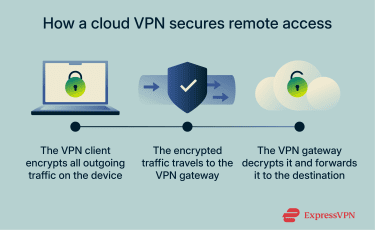
Benefits of a cloud VPN
A cloud VPN offers several advantages for organizations that rely on remote access or cloud-based workloads, including:
- Encrypted access: Protects data in transit when connecting to cloud applications or internal resources.
- Scalable capacity: Expands quickly to support remote workforces or growing teams.
- Lower maintenance: Removes the need to manage physical VPN hardware or on-site infrastructure.
- Centralized control: Provides unified management and monitoring through cloud dashboards.
- Reduced latency: Can connect users to nearby cloud regions for improved performance, depending on routing and workload location.
- High reliability: Uses multiple data centers to keep services running even if one location encounters issues.
How a cloud VPN impacts privacy and security
When implemented correctly, a cloud VPN improves security and helps protect data across distributed environments while reducing the risks that come with unmanaged remote access. Because the VPN gateway runs in the cloud, users can connect securely from virtually any location without exposing internal systems directly to the internet.
Centralized controls also allow organizations to enforce consistent access policies, monitor activity, and revoke permissions quickly when needed. At the same time, relying on a cloud provider introduces shared-responsibility considerations: the provider manages the infrastructure and uptime, while the organization must still secure user accounts, identity systems, and the data hosted on its services.
Common use cases for a cloud VPN
- Remote workforce access: Provides secure connections for employees working from home or traveling.
- Hybrid infrastructure: Links on-premises networks with cloud environments without exposing internal systems directly to the internet.
- Multi-cloud connectivity: Secures communication between services hosted across different cloud providers.
- Third-party or contractor access: Grants limited, controlled access to specific resources without opening the entire network.
- Secure access to internal apps: Protects sensitive tools or databases that cannot be made publicly accessible.
- Regulated industries: Supports compliance by encrypting data in transit across distributed environments.
Further reading
- Cloud VPN: A detailed guide
- Security concerns in cloud computing and how to address them
- What is a site-to-site VPN, and how does it work?
 Support Center
  FAQ
FAQ  VPN Setup Tutorials