Expressvpn Glossary
Data intelligence

What is data intelligence?
Data intelligence is the process of collecting, organizing, and analyzing data to extract meaningful insights and apply them to support informed decision-making.
How does data intelligence work?
Data intelligence uses a combination of methods and automated tools. First, the system collects information from relevant sources, such as sales figures or website analytics, and brings it together in centralized systems where it is cleaned and prepared for analysis.
The system then applies advanced analytics using AI, including machine learning (ML) and generative AI, to identify meaningful patterns. Based on this analysis, the platform generates insights and recommendations, which are delivered through dashboards or reports and continuously improved over time.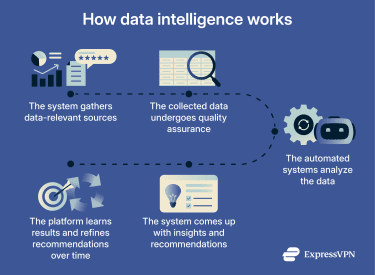
Key components of data intelligence
Data intelligence includes the following core components:
- Automated metadata collection: Automatically gathers and integrates metadata, which is information about data, from various sources into centralized storage.
- Metadata management: Helps organizations locate trusted data assets and understand the relationships between them.
- Data cataloging: Involves creating and maintaining a centralized inventory of data assets, such as files, tables, and databases.
- Data lineage: Makes it possible to trace and understand how data flows throughout an organization’s systems.
- Data mapping: Links databases and enables them to communicate and is an essential step when planning data migration.
- Data governance: Encompasses measures that ensure data integrity and security while supporting regulatory compliance.
- AI models: Automatically analyze large data sets, generate predictive insights, provide actionable recommendations, and visualize results.
Why data intelligence matters
Data intelligence matters because it helps organizations turn large volumes of data into clear, actionable insights that improve decision-making. By revealing patterns, trends, and opportunities that would otherwise be hidden, it enables teams to act faster, reduce risk, and make more informed choices based on evidence rather than intuition.
How data intelligence impacts privacy and security
Data intelligence enhances privacy and security by continuously monitoring data quality and identifying issues or anomalies in real time. It helps organizations track how data flows across systems, making it easier to spot potential security risks such as unauthorized access or misuse. In addition, data intelligence supports strong access controls and governance practices, ensuring users can only interact with data that is relevant to their role and compliant with privacy regulations.
Common use cases for data intelligence
Data intelligence can be applied across almost any industry or department, with common examples including:
- Healthcare: Hospitals and clinics use data intelligence to analyze medical histories, treatment outcomes, and current symptoms to deliver more accurate diagnoses and improve patient care.
- Financial services: Organizations in this sector use automated systems to predict economic trends, detect fraudulent transactions, manage financial risks, and ensure regulatory compliance.
- Marketing teams: Leverage data intelligence to better understand buyer interests and behaviors, craft personalized messages, and predict which customers are most likely to engage with specific offers.
- Online retailers: Ecommerce platforms use data intelligence to analyze customers’ past orders and browsing habits, enabling more personalized shopping experiences.
- Education: Learning institutions use AI models to assess classroom performance, detect learning gaps, and update teaching strategies accordingly.
Further reading
- What is data privacy and why it matters: A complete guide
- How to hide your IP address and protect your online privacy
- What is data anonymization? Benefits, methods, and best practices
 Support Center
  FAQ
FAQ  VPN Setup Tutorials